Following publication of this article, EUDR has been further delayed until 30 December 2026. A simplification review will be published by 30 April 2026.
Soyabeans are one of the world’s most traded agricultural commodities. They are also the key protein in global animal feed. UK imports of soyabeans and soyabean meal have averaged 895,000 tonnes and 2 million tonnes respectively over the past five-years. As such, global developments in soyabean prices have a marked impact on the price of animal feed in the UK.
There have been two key drivers of soyabean prices in the last month. The first is the changes to the implementation of the EU Deforestation Regulation (EUDR) and the second is trade talks between China and the US.
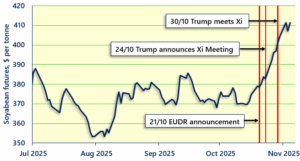
Source: Chicago Merchantile Exchange
EU Deforestation Regulation
The EUDR requires EU companies purchasing and processing soyabeans and soyabean derivatives to report that the products are not from a source which is linked to deforestation. Earlier this year, it had been suggested that the EUDR implementation could be further delayed to December 2026. However, the EU Commission has now confirmed that EUDR, albeit in a watered down form, comes into force in the New Year.
The introduction will be phased; medium and large enterprises will have to commence reporting from 30th December 2025. Meanwhile micro and small enterprises will have until December 2026 to comply. For the first six months, the Commission focus will be on information collection and prevention. This is to allow companies to adapt to the new requirements. From 30th June 2026, non-compliance will result in penalties.
The EU Commission has watered-down the reporting requirements so they now only apply to the organisation who first places the product onto the market. The requirement to report will only apply at the stage of import or first sale in the EU.
Those with reporting requirements will be required to submit a Due Dilligence Statement (DDS) which states where the product is harvested (precise geolocation). The location of the where the crop is grown is then compared to historic mapping to see if the location was a ‘forest’ at any time since 31st December 2020. This information is then added to Customs declarations.
Whilst the simplified requirement for reporting reduces the administrative burden, providing information on crop location for soyabeans on a 60,000-80,000 tonne boat from Brazil to Amsterdam will still be challenging. This in turn is likely to increase the cost of soyabeans, into the new year. The EUDR also applies to Palm Oil and Cattle (i.e. beef products).
US-China Trade Talks
China is responsible for 60% of global soyabean imports. As a result, shifts in Chinese demand have a significant impact on global pricing. The recent trade war between the US and China has had marked impact on global soyabean markets. With China not buying from the US, prices had been pressured. However, talks between Presidents Trump and Xi, announced on 24th October and held on 30th October, have increased the volume of imports due flow to China from the US.
China is reported to be buying an additional 12 million tonnes of soyabeans from the US, following the talks. However, there is no official confirmation of how much China has purchased, with the US export sales currently not being reported due to the US Government shutdown.
The volume of soyabeans China has announced it will buy falls short of historic purchases from the US. Since the last Trump presidency (and US-China trade war in 2018) China has diversified its import origins investing significantly in Brazilian infrastructure to de-risk its supply.
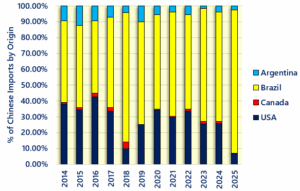
Source: UN Comtrade